
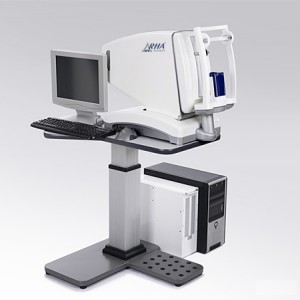
 New technology, “a major advancement in retinal health management,” is now offered at Lange Eye Institute in The Villages.
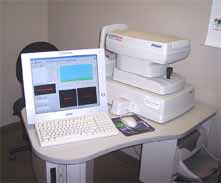
The Annidis RHA™ system combines advanced Multi-Spectral Imaging (MSI) technology with multi-image software processing for early detection of ocular pathologies such as age related macular degeneration, diabetic retinopathy and glaucoma.
 Dr. Lange is excited to announce that Lange Eye Care and Associates is using a new at home monitoring device developed for macular degeneration patients called

 Alcon is a Registered Trademarks of Alcon, Inc
 Acrysof® is a Registered Trademarks of Alcon, Inc


 Without Glasses?!! that is worth everything to me!
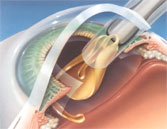
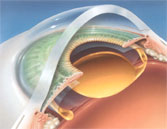
  Cataract surgery has undergone tremendous technological advances since the days of your parents and grandparents. This year, millions of patients will choose to have both their vision and their lifestyles restored, thanks to this life-changing medical procedure.
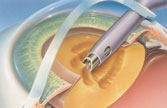
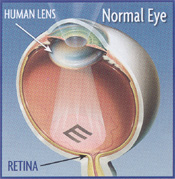 A cataract is a clouding of the natural lens inside your eye. This lens, located behind the iris (or colored part of the eye) works just like the lens of a camera – focusing light images on the retina, which sends the images to your brain.
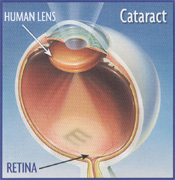 A cataract can be the reason sharp images become blurred, bright colors become dull, or seeing at night is more difficult. It may also be why the reading glasses or bifocals that used to help you read, or do other simple tasks, no longer seem to help. Unfortunately, cataracts can’t be prevented, but removing the cataract and replacing it with and artificial lens can restore your vision and in many ways, significantly improve your quality of life. The time to have your cataracts removed is when the quality of your vision begins to put limits on your activities and enjoyment of life.
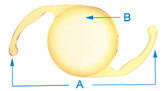
  Intraocular lenses were first introduced in 1949 and are available today in all kinds of shapes, sizes, and lens materials. AcrySof® IOLs are made of the first foldable material developed exclusively for use in the eye. With more than 21 million lenses implanted, the AcrySof® lens has been the most commonly used IOL in the world, since they became available in 1994. Its popularity is largely due to their ability to provide excellent visual results and a high level of patient satisfaction.

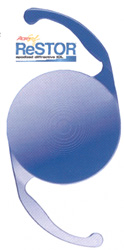 As with any surgical procedure there are inherent risks, and your results cannot be guaranteed. Your doctor will provide you with more detailed information about potential risks and benefits to help decide whether cataract surgery and the AcrySof® ReSTOR® IOL is right for you.
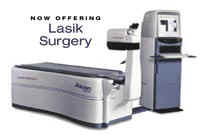 For over 25 years doctors placed incisions in the cornea to treat nearsightedness, farsightedness, and astigmatism. In the early 1980’s, they began looking at lasers to improve the precision and predictability of altering the shape of the cornea. Researchers found that the Excimer laser could remove tissue with up to 0.25 microns of accuracy. Now, in its second decade of use, the technologically advanced Excimer laser has added a tremendous amount of precision, control and safety to the surgical correction of vision errors. Using this remarkable technology, the cornea is reshaped to conform to your glasses or contact lens prescription, thereby reducing or even eliminating a lifetime of dependence on corrective lenses for hundreds of thousands of Americans every year.
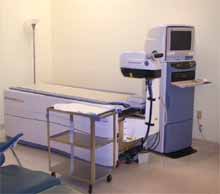 After your eye has been completely numbed using “eye drop” anesthesia, an eyelid holder will be placed between your eyelids to prevent you from blinking.
 Myopia
 The decision to have LASIK is an important one that ultimately, only you man make. It is important that you have realistic expectations and that your decision is based on facts, not hopes or misconceptions. The goal of LASIK is to reduce your dependence on corrective lenses. LASIK does not always create 20/20 or even 20/40 vision. It cannot correct a condition known as presbyopia, or aging of the eye. This normally occurs around age 40 and may require the use of reading glasses. In fact, people over 40 who have their distance vision improved with LASIK, may find they need reading glasses after the procedure. Your doctor will provide you with additional information that will allow you to make an informed decision.
 In The Blink Of An Eye
 If you are interested in LASIK procedure or just have questions concerning LASIK eye surgery please feel free to call our offices in The Villages at the following numbers: